828 Daily
Archives
Controversial Headlines: Recovery Grants, Budget Adoption, Emergency Hub, Future of Owen Park, Public Comment, Library Fest, Land Trust Day, Whataburger in Asheville!

Subscribe
Controversial Headlines: Recovery Grants, Budget Adoption, Emergency Hub, Future of Owen Park, Public Comment, Library Fest, Land Trust Day, Whataburger in Asheville!
828 Daily
Archives
Controversial Headlines: Recovery Grants, Budget Adoption, Emergency Hub, Future of Owen Park, Public Comment, Library Fest, Land Trust Day, Whataburger in Asheville!
Chris Paris
Jun 2, 2026
𝐇𝐚𝐩𝐩𝐲 𝐓𝐮𝐞𝐬𝐝𝐚𝐲, 𝟖𝟐𝟖! |
June is here, and Asheville is easing into summer with library events, downtown music, mountain outings, local business updates, arts happenings, and community recovery news worth keeping on your radar.
In today’s edition, we’re helping you plan the week, check in on neighborhood changes, support local businesses, and find easy ways to enjoy Asheville, Buncombe County, Weaverville, Swannanoa, and the wider Western North Carolina mountains.
New to the area? We’re glad you’re here. |
 |
 |
Trivia Question❓What scenic roadway near Asheville is known for mountain overlooks, fall color drives, hiking access, and sections that may close due to weather or maintenance? Answer at the bottom of the newsletter |
 |
Asheville Small Business Recovery Grant Program Opens June 15 |
Asheville small business owners still working through the long recovery from Helene will soon have a new grant opportunity to help cover unmet storm-related losses.
The City of Asheville has announced the Asheville Recovers Together Small Business Grant Program, a disaster recovery effort funded through federal Community Development Block Grant–Disaster Recovery dollars. Applications are scheduled to open Monday, June 15, 2026, at noon and close Tuesday, July 14, 2026, at noon. Grant awards are expected to range from $5,000 to $75,000 for eligible businesses.
The program is designed for businesses with a principal location inside Asheville city limits that were operating before September 27, 2024, and still have financial losses from Helene after accounting for insurance and other relief funding. Award decisions will consider factors such as physical storm damage, lost revenue, previous recovery funding, and expected job retention or creation.
For local restaurants, shops, artists, makers, service businesses, and entrepreneurs, the grants could provide meaningful support after months of uneven recovery. Many small businesses faced not only direct storm damage, but also lost sales tied to water disruptions, tourism slowdowns, repairs, staffing challenges, and the broader economic impact of Helene across Western North Carolina.
The program will be administered through a local partnership that includes Mountain BizWorks, ArtsAVL, and Eagle Market Streets Development Corporation. That structure is intended to help the funding reach a broad mix of Asheville businesses, including creative businesses and entrepreneurs who may not always think of themselves as traditional small business owners.
Business owners do not have to wait until the application window opens to start preparing. Application previews, eligibility details, and one-on-one assistance are available through the program, and a public kickoff event is scheduled for June 11 at 9:30 a.m. at the YMI Cultural Center.
For many Asheville neighborhoods, this grant program is about more than individual businesses. Small businesses are part of the city’s daily rhythm: the coffee shops, studios, restaurants, retailers, repair services, wellness providers, and neighborhood spots that help define Asheville’s local economy and culture.
As recovery continues, this funding could help more of those businesses stabilize, retain workers, and keep serving the community. Business owners should review eligibility requirements carefully, gather documentation of storm-related losses, and make note of the application window before it opens on June 15. |
Buncombe County adopts FY2027 budget |
Buncombe County Commissioners have approved a $484.4 million budget for Fiscal Year 2027, setting spending priorities for county services, public safety, schools, health programs, libraries, housing, conservation, and community support.
The budget was adopted on June 2 and outlines how the county plans to fund day-to-day services while also investing in longer-term needs across Buncombe County.
For residents, some of the most visible investments are tied to emergency response. The budget includes additional support for fire service, EMS bases, and emergency preparedness, areas that have remained especially important as Western North Carolina continues to think about resilience, response times, and disaster readiness following Helene.
Education and public services also remain major priorities. The budget includes funding for schools, libraries, public health, and youth-focused programs. These are the kinds of county services that touch residents directly, whether through classrooms, branch libraries, health resources, or programs for children and families.
The adopted budget also includes investments in affordable housing, conservation, and the arts. Those areas have been ongoing community discussion points in Buncombe County, where housing costs, growth pressure, and quality-of-life issues continue to shape local priorities.
County budgets can feel technical, but they often affect everyday life in practical ways: how quickly emergency crews can respond, what resources are available at local libraries, how public health programs are supported, and how much funding is directed toward schools, parks, housing, and community organizations . For Buncombe County residents, the FY2027 budget gives a clear look at where local leaders are choosing to place resources for the year ahead. The biggest takeaway is that the county is pairing core government services with investments in resilience, community health, education, housing, conservation, and cultural life.
Residents who want to follow specific projects, department funding, or future bond discussions can review county budget materials and upcoming commissioner meeting agendas through Buncombe County’s official channels. |
 |
A Taste of Tradition. A Gift of Hope.
We’re proud to carry forward the Regas legacy through The Original Family Recipe by Regas Bros Seasoning—a revival of Frank G. Regas’ iconic blend.
Rooted in a philosophy of fresh ingredients, bold flavors, and genuine hospitality, this seasoning continues to inspire chefs, restaurateurs, and home cooks alike.
More than just great flavor, every purchase has purpose—all proceeds support the Alzheimer’s Foundation, honoring Frank, his sister, and the countless families impacted by the disease.
💜Taste the tradition. 💜Support a cause. 💜Love what you eat
|
Former JCPenney Site Could Become Buncombe County Emergency Operations Hub |
Buncombe County is taking a closer look at the former JCPenney space at Asheville Mall as a possible new hub for emergency response and county operations.
County Commissioners have authorized staff to begin purchase negotiations for the property, a move that could eventually allow Buncombe County to consolidate several operational functions into one large, centrally located site. The county has described the location as a potential home for emergency management and other behind-the-scenes county needs.
The proposal is especially relevant as Buncombe County continues to evaluate local preparedness, response capacity, and recovery needs after Helene. A larger operations hub could give the county more room to coordinate emergency response, store supplies, house equipment, and support county departments that need reliable space during major weather events or community-wide disruptions.
County officials have said no public-facing operations are planned for the former retail space. That means residents should not expect the site to function like a customer-service center, public office, or walk-in county department. Instead, the focus would be on internal operations that support emergency response and county services.
The former department store location could offer several practical advantages, including size, parking access, loading areas, and proximity to major roads. Large retail properties are sometimes attractive for government operations because they can be adapted for storage, logistics, office space, training, and coordination work.
For Asheville Mall and the surrounding area, the potential purchase also reflects a broader trend affecting many older retail spaces. As traditional department store footprints change, communities are increasingly looking at how large vacant or underused spaces can serve new purposes.
The county has not finalized the purchase. Commissioners’ action allows negotiations to move forward, but additional steps would likely be needed before any redevelopment, renovation, or occupancy plans are complete.
For residents, the main takeaway is simple: Buncombe County is exploring the former JCPenney site as a possible operational base to strengthen emergency readiness and county coordination, not as a new public service counter. |
 |
Residents Invited to Help Shape the Future of Owen Park |
A major recovery milestone is coming up for Charles D. Owen Park in Swannanoa.
Residents are invited to review design concepts for the park’s future during a drop-in workshop on Tuesday, June 16, from 4–7 p.m. at the Bee Tree Fire Substation. The meeting will give community members a chance to see proposed ideas, ask questions, and share feedback as Buncombe County works toward rebuilding the storm-damaged park.
Owen Park has long been a favorite spot for families, walkers, youth sports, picnics, and outdoor time in the Swannanoa Valley. After Helene, its recovery has become an important local project for residents who want to see public spaces restored in a thoughtful, resilient way.
The workshop is a good one to watch for families, outdoor users, and anyone following recovery progress in Swannanoa. Spanish-language interpretation will also be available. |
Asheville Public Comment Period Closes June 5 |
Asheville residents have until June 5 to submit public comments on the city’s community development Action Plan.
The comment period is a practical civic reminder for anyone following housing, neighborhood investment, recovery-related funding, and local programs that shape quality of life across the city. These plans help guide how certain community development dollars are used, including support for priorities such as affordable housing, neighborhood improvements, and services for residents.
For readers who care about where public resources go, this is a good moment to review the plan and share feedback before the deadline. Public comment opportunities like this are one way residents can weigh in before funding decisions move forward.
The takeaway: Asheville’s public comment window closes June 5, so residents who want to participate should submit feedback before the deadline. |
 |
Summer Library Fest kicks off Saturday, June 6 |
Buncombe County Public Libraries is launching summer reading with Summer Library Fest on Saturday, June 6, from 10 a.m.–1 p.m. at East Asheville Library. It’s a family-friendly pick for parents, teens, tweens, and anyone looking to map out a good summer of reading, activities, and library fun. |
Land Trust Day Brings Conservation Focus to Downtown Asheville |
Mast General Store in downtown Asheville will host Land Trust Day on Saturday, June 6, highlighting the work of the Southern Appalachian Highlands Conservancy and its efforts to protect the mountains, farms, forests, and natural spaces that make Western North Carolina special.
The event is a good fit for shoppers, gardeners, outdoor lovers, and anyone who wants to learn more about local conservation. Visitors can expect a community-minded stop with conservation information, wildflower starts, and a chance to support a regional nonprofit while shopping downtown.
For Asheville residents, Land Trust Day is also a reminder that local outdoor access and mountain views do not happen by accident. Behind many protected ridgelines, trails, farms, and scenic places are years of conservation partnerships and community support.
It’s an easy weekend add-on: stop by Mast General Store, learn a little more about land protection in the Southern Appalachians, and make time for a downtown coffee, lunch, or gallery stroll while you’re there. |
Asheville Art Museum Gala Supports the Local Arts |
The Asheville Art Museum Gala is set for Saturday, June 6, from 5–9 p.m. downtown, offering an evening focused on celebrating and supporting the region’s arts community.
This is a higher-end community event rather than a casual family outing, making it a good fit for readers interested in arts, culture, philanthropy, and downtown Asheville’s creative scene. Gala events like this help support museum programming, exhibitions, education, and the broader role the museum plays in local cultural life.
For Asheville residents who enjoy supporting the arts, the gala is a polished Saturday evening option and a reminder that local museums depend on community participation to keep exhibitions, events, and arts education accessible throughout the year. |
 |
Music on Main returns to Weaverville on Saturday, June 13 |
Downtown Weaverville will host Music on Main on Saturday, June 13, bringing a free, family-friendly evening of live music, kids’ activities, food, and small-town summer energy. It’s an easy pick for families, neighbors, and anyone looking for a relaxed night out just north of Asheville. |
Downtown After 5 brings free live music to Pack Square Park on June 19 |
Asheville’s Downtown After 5 concert series returns Friday, June 19, with a free evening of live music, food vendors, and downtown energy at Pack Square Park. It’s a strong after-work or weekend-kickoff pick for locals looking to enjoy music, grab dinner from vendors, and spend a summer evening in the heart of Asheville. |
 |
 |
One Local Thing: The River Arts District’s Comeback After Helene |
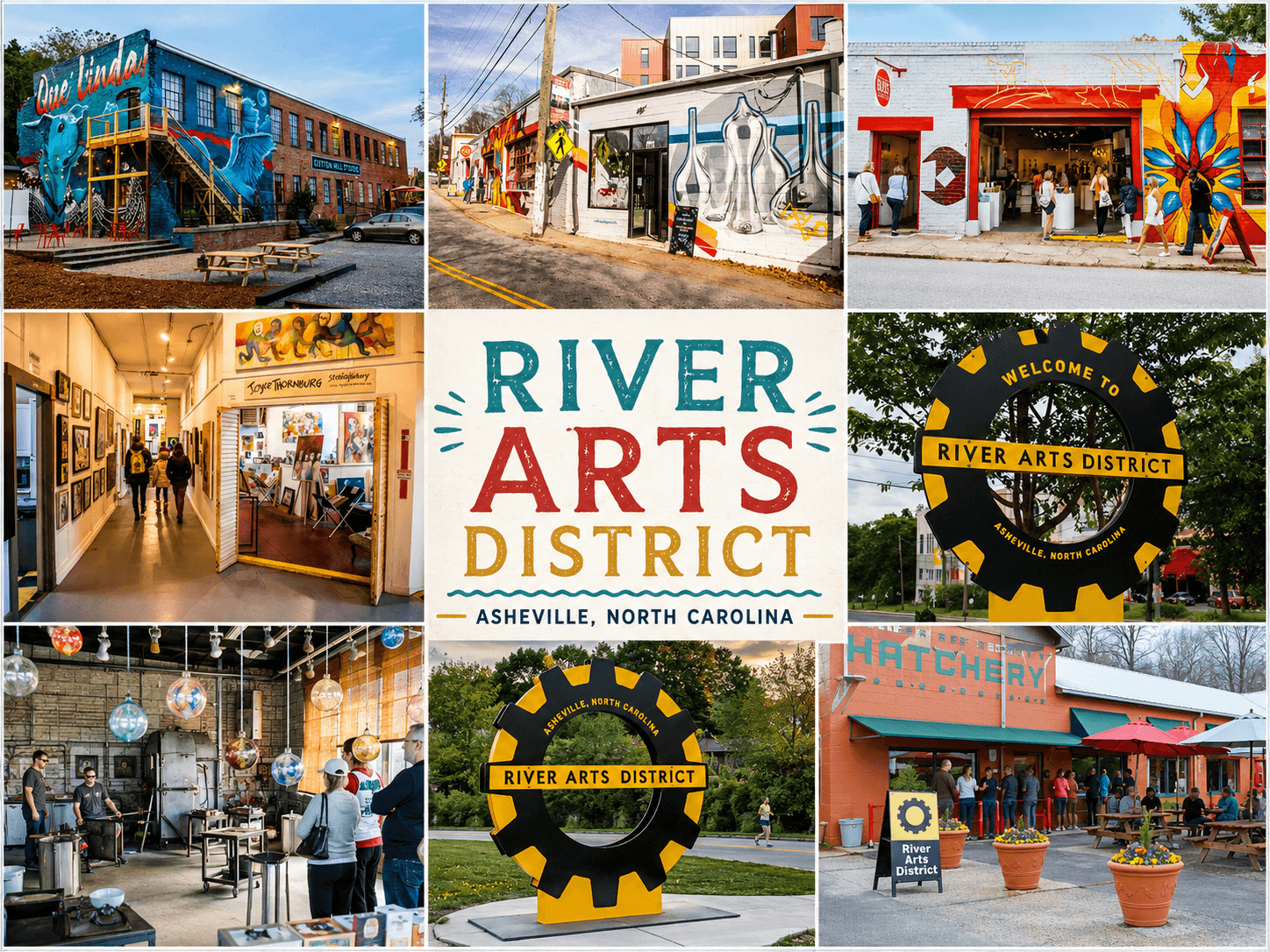
Before Hurricane Helene, Asheville’s River Arts District was one of the city’s most recognizable creative destinations. Set along the French Broad River, the district turned old industrial buildings, warehouses, and riverfront spaces into a working arts community filled with studios, galleries, restaurants, breweries, workshops, murals, and maker spaces.
It was not just a place to look at art. It was a place to meet the people making it.
Visitors could walk into studios, watch artists shape glass, paint, sculpt, throw pottery, print, weave, and create, often with the artist standing just a few feet away. For locals, the RAD became one of those Asheville places that helped define the city’s personality: creative, independent, hands-on, colorful, and deeply connected to Western North Carolina’s maker culture.
Then Hurricane Helene changed the district almost overnight.
Flooding from the French Broad devastated large portions of the River Arts District, damaging studios, tools, artwork, buildings, restaurants, and gathering spaces. Early reports described the destruction as severe, with estimates that roughly 80% of the district was damaged or destroyed. The impact was not only physical. It hit the livelihoods of artists, small businesses, and creative workers who depended on the district as both a workplace and a community.
More than a year later, the story is still unfolding. The River Arts District is open again, but it should not be described as “back 100%.” A better and more accurate way to say it is this: the RAD is open, active, and rebuilding, with recovery still continuing in some areas.
That distinction matters because the district’s comeback is not a simple before-and-after story. Some studios and galleries have reopened. Some artists have returned. Others were displaced or had to find new creative spaces. The official River Arts District Artists organization says more than 500 artists have returned to create and exhibit in reopened artist-owned studios and galleries, while its foundation continues to support long-term recovery, creative spaces, events, scholarships, and revitalization efforts.
The district’s own history page also notes that the Upper RAD is now open, while efforts continue to support Lower RAD artists, reopening spaces, rebuilding studios, improving wayfinding, and helping visitors reconnect with the district.
That makes this a meaningful time to visit.
A walk through the River Arts District today is not just a casual Asheville outing. It is a chance to support artists directly, discover reopened studios, buy local work, attend art events, and see how one of Asheville’s most beloved creative communities is shaping its next chapter.
For 828 Daily readers, this is the kind of local place worth revisiting with fresh eyes. Stop into a gallery. Attend a Second Saturday Art Stroll. Visit a working studio. Grab lunch or coffee nearby. Share an artist’s work online. Bring out-of-town guests, but let them know the district is not just a tourist stop. It is a living, rebuilding creative neighborhood.
The River Arts District’s comeback is still in progress, and that may be what makes it such a powerful local story. It shows how deeply art, place, small business, history, and community are connected in Asheville.
Local takeaway: |
 |
 |
Check Blue Ridge Parkway Conditions Before Your Next Mountain Drive |
The Blue Ridge Parkway is one of Western North Carolina’s favorite ways to spend a free morning, plan a scenic drive, reach a trailhead, or show off the mountains to visiting friends and family. But before heading out, there is one simple step that can save a lot of frustration: check current Parkway road conditions first.
Although the Parkway is generally open year-round, individual sections can close with little notice because of weather, maintenance, construction, storm recovery work, rockslides, fallen trees, or hazardous driving conditions. In the mountains, conditions can also change quickly from one overlook to the next, especially at higher elevations.
That means a route that looks simple on a map may not always be available in real life. A planned drive from Asheville toward Mount Pisgah, Craggy Gardens, or another favorite overlook can be affected by temporary closures, detours, or limited access points.
For local residents, the reminder is especially useful during weekend planning. Checking conditions ahead of time can help families choose a realistic outing, hikers confirm trailhead access, and drivers avoid backtracking on narrow mountain roads. It can also help visitors make safer decisions when they are unfamiliar with Parkway entrances, elevation changes, and mountain weather.
The best habit is to check the official road status before leaving home, then stay flexible. If a section is closed, there are usually still plenty of nearby options, from lower-elevation greenways and city parks to state forests, waterfalls, downtown strolls, and scenic drives outside the closed area.
A few smart Parkway tips:
The Parkway remains one of the region’s great everyday treasures, but a little planning goes a long way. Before your next mountain outing, make the road-condition check part of the routine. |
 |
Whataburger Files Plans for First Asheville Location |
Whataburger appears to be moving toward its first Asheville restaurant, with permits filed to convert the former Popeyes location at 275 Smokey Park Highway.
According to the permit report, the Texas-based burger chain is planning renovations at the site, which would bring a new fast-food option to the west side of Asheville. The location sits along a busy commercial corridor with easy access for drivers, nearby neighborhoods, and travelers moving through the Smokey Park Highway area.
For now, this should be treated as a planned project, not an opening announcement. The permits were still under review as of the report, and no construction timeline or opening date had been listed.
If approved and completed, the Asheville restaurant would mark Whataburger’s first local location and add another recognizable national brand to the city’s fast-food mix. Residents should watch for future updates from the City of Asheville permit system or the company before making opening-week plans. |
828 Local Facts Worth Knowing |
|
|
 |
💡 Answer to Trivia Question: Blue Ridge Parkway |
|
Thanks for reading 828 Daily. |
We’ll keep bringing you useful local updates from Asheville and surrounding areas — from weekend events and outdoor ideas to road reminders, new openings, community news, and the small details that make life here easier to navigate.
Have a great weekend, and we’ll see you in the next edition |